
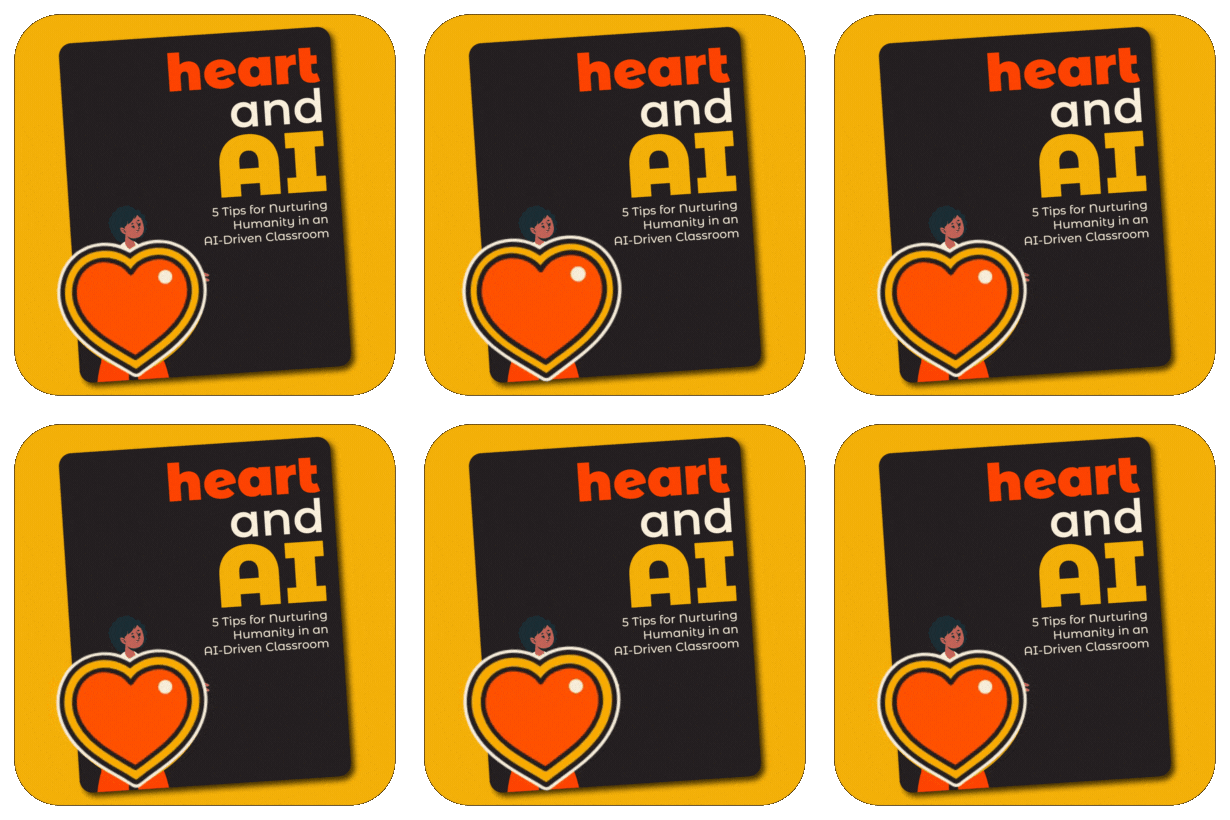
Heart, Human & AI
5 Tips for Nurturing Humanity in an AI-Driven Classroom
by Frankie Cilliers · 3 Jan 2025
It's truly remarkable how rapidly our tech world is evolving. Technology, especially AI, is really transforming everything around us, how we approach things, including our classrooms.
While AI offers incredible potential for personalised learning, automating tasks, and boosting efficiency, it's crucial to remember the importance of the human connection and creativity in our classrooms. As teachers, we all want to help our students grow into amazing people who can adapt to an ever-changing world.
And yes, AI can absolutely lend a hand, but it's how we use it that really matters. As we implement AI, we should do it in a way that still encourages our students to think for themselves, come up with new ideas, understand others, and manage their own emotions.
Those are the things that will really help them succeed in the long run - these skills are not only irreplaceable but also essential for navigating the complexities of life.
AI and the human touch - finding the balance

1. AI and Human Artwork
Imagine the creative possibilities when our students explore the world where AI meets human art!
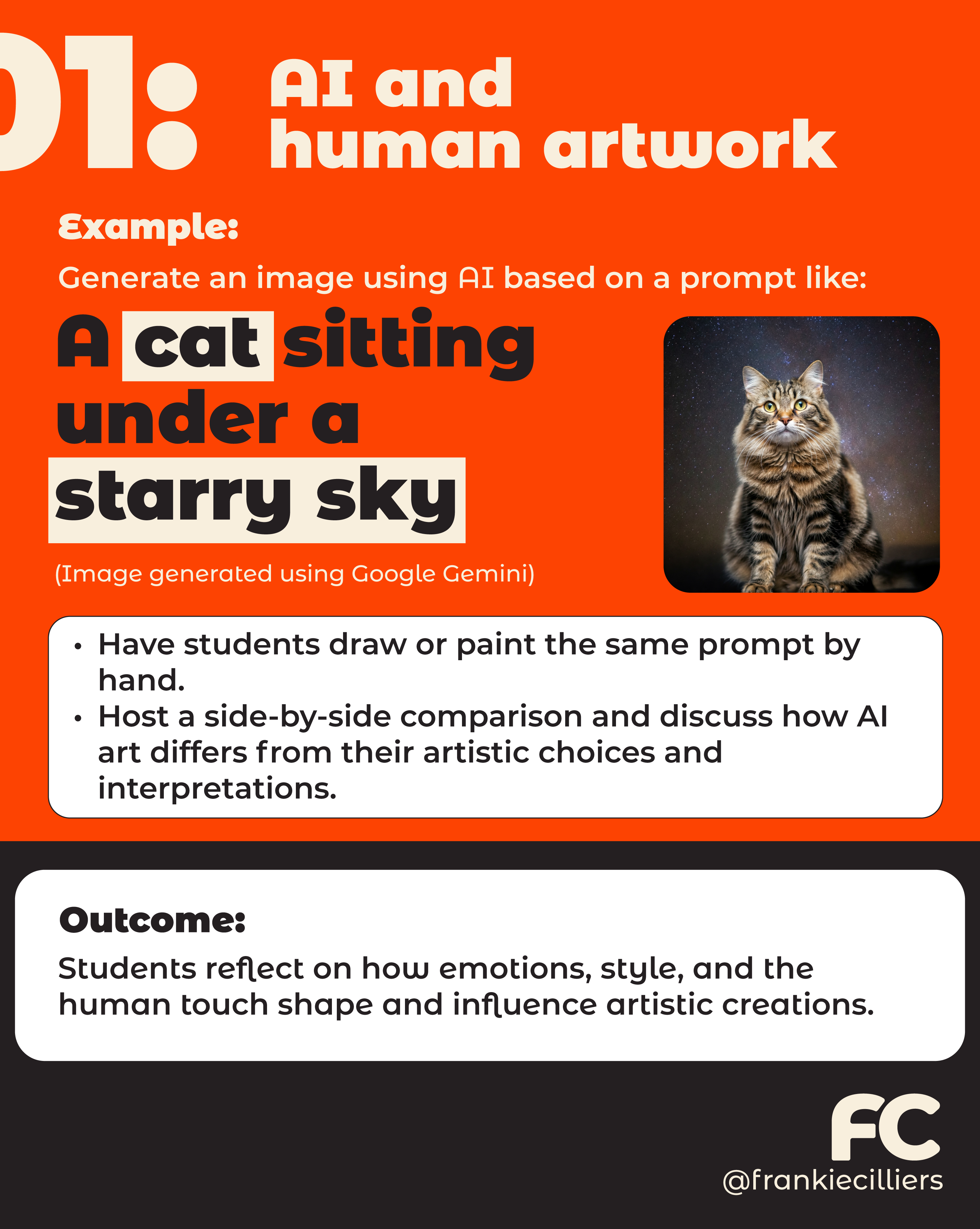
Imagine a classroom buzzing with excitement as students discover the power of art through AI! We can start by giving them the keys to a whole new world of artistic creation – AI image generation. They can type in words and phrases, watching in amazement as their ideas turn into stunning visuals. It's like magic, but it's also a powerful tool for sparking their own creativity and discussions around ethics.
Encourage students to step away from the screens and pick up their favourite art supplies. Think paint, pencils, charcoal, maybe even clay! The challenge? To recreate those AI-generated images in their own unique style.
As they bring those digital creations to life on paper or canvas, they'll start to understand the incredible nuances of human artistry. They'll feel the texture of the paintbrush on the canvas, the subtle shift in colour as they blend their pencils, and the way their own hand movements translate into unique lines and shapes.
These are things that AI can't replicate, and it's through this hands-on experience that students will be able to truly appreciate the magic in their own hands.
And to top it all off, get your students talking! Encourage them to take part in discussions where students compare their artwork with the AI's creations, or where they ask thought-provoking questions:
What's different?
What's similar?
Do you prefer one over the other and why?
How does AI image generation affect artists or designers trying to make a living?
This is where things get really interesting, as they start to explore the big questions about creativity, both human and artificial. It's a chance to dive deep into what makes us unique and how technology can help us express ourselves in new and exciting ways, but also how we can retain the human magic and respect for art created by humans.
2. AI and Storytelling
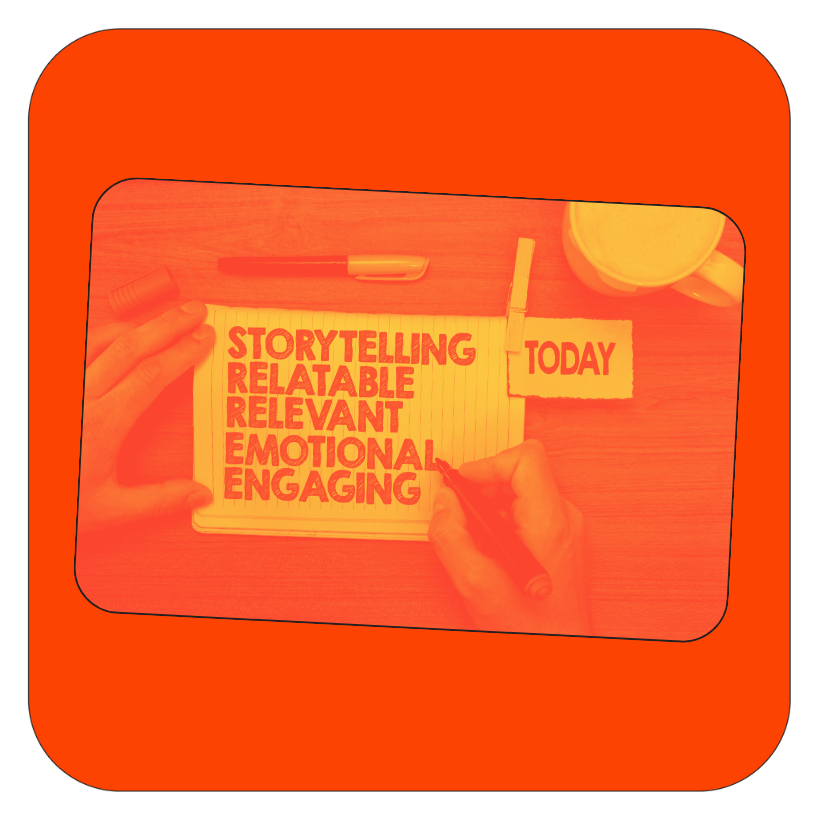
AI tools can be a fantastic starting point for storytelling.
AI can become a collaborator in storytelling. It's like having a co-writer who can whip up amazing story beginnings in the blink of an eye!
Example: Students can give the AI a simple prompt – maybe a mysterious object, an unusual setting, or a captivating first line – and watch as it generates the opening scene of a brand-new tale.
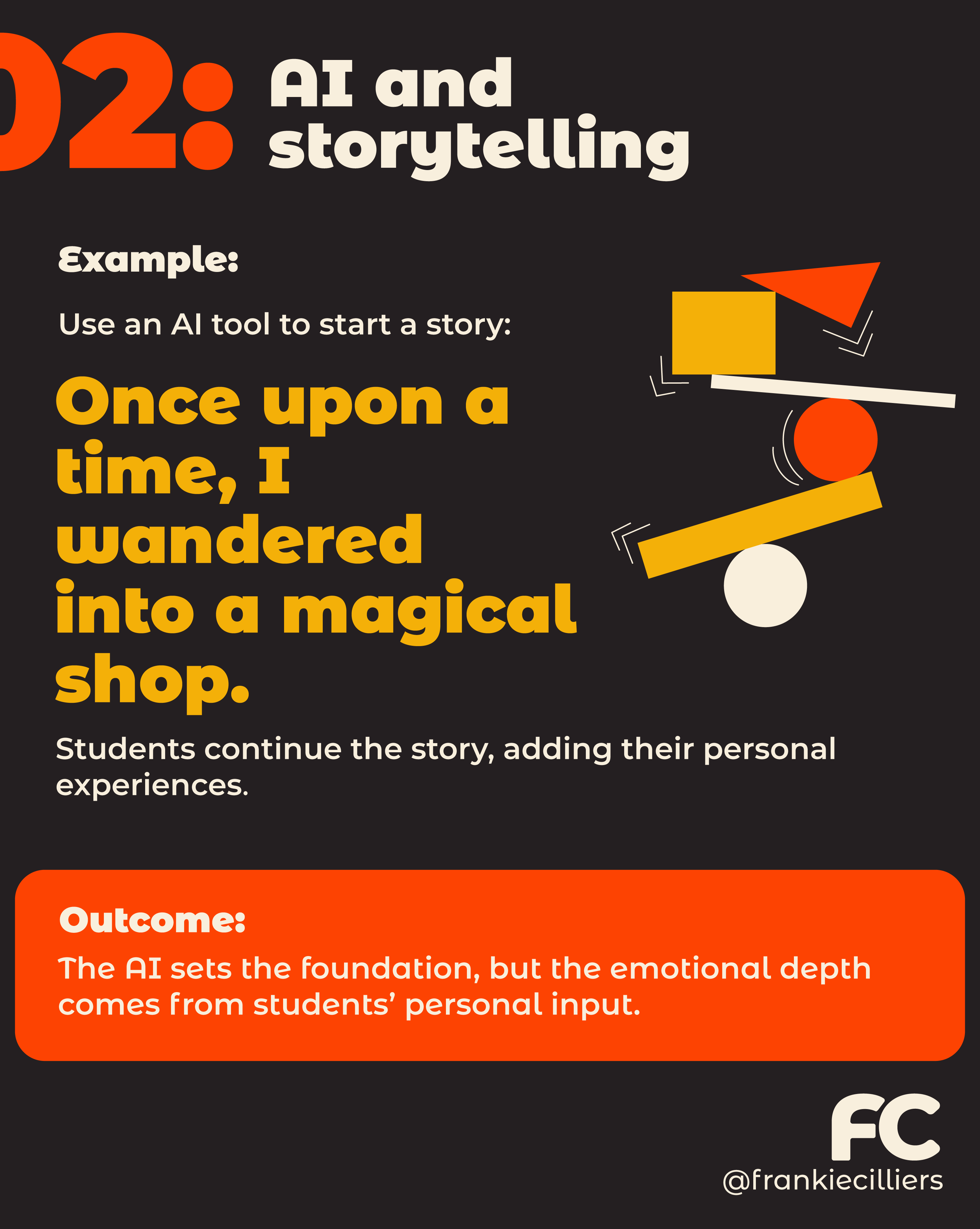
But here's where the real fun begins: The students take over! They become the authors, adding their own unique voices and imaginations to the AI's foundation. They might introduce quirky characters, unexpected plot twists, or even delve into deeper themes that resonate with them.
It's like a creative relay race, with AI passing the baton to the students to run with their own ideas.
This process not only helps them hone their storytelling skills but also shows them the incredible power of human imagination.
They'll see how AI can be a fantastic tool for inspiration, but ultimately, it's their own creativity that brings the story to life. And because they're building on a foundation that excites them, they'll be even more invested in making the story their own.
Students can weave in their own experiences, emotions, and perspectives that make the narratives truly unique and personal.
It's like taking a journey into their own imaginations, guided by a spark from AI.

3. AI with Empathy
AI tools can team up with students to refine their feedback, and also encourage them to explore ways to make AI feedback more human, helping them learn how to communicate more effectively and empathetically.
AI can also step in as a writing coach for students, offering suggestions and feedback on their work. That's pretty fantastic, right? But here's the thing: even AI can sometimes sound a little, well, robotic. It might point out areas for improvement, but in a way that feels blunt or impersonal.
That's where our human touch comes in! We can encourage students to look beyond the AI's initial feedback and think about how to rephrase it in a more encouraging and empathetic way:
Instead of just saying "This sentence is too long," students might suggest, "This sentence is packed with great ideas! Maybe we could break it up a bit to make it easier to follow."
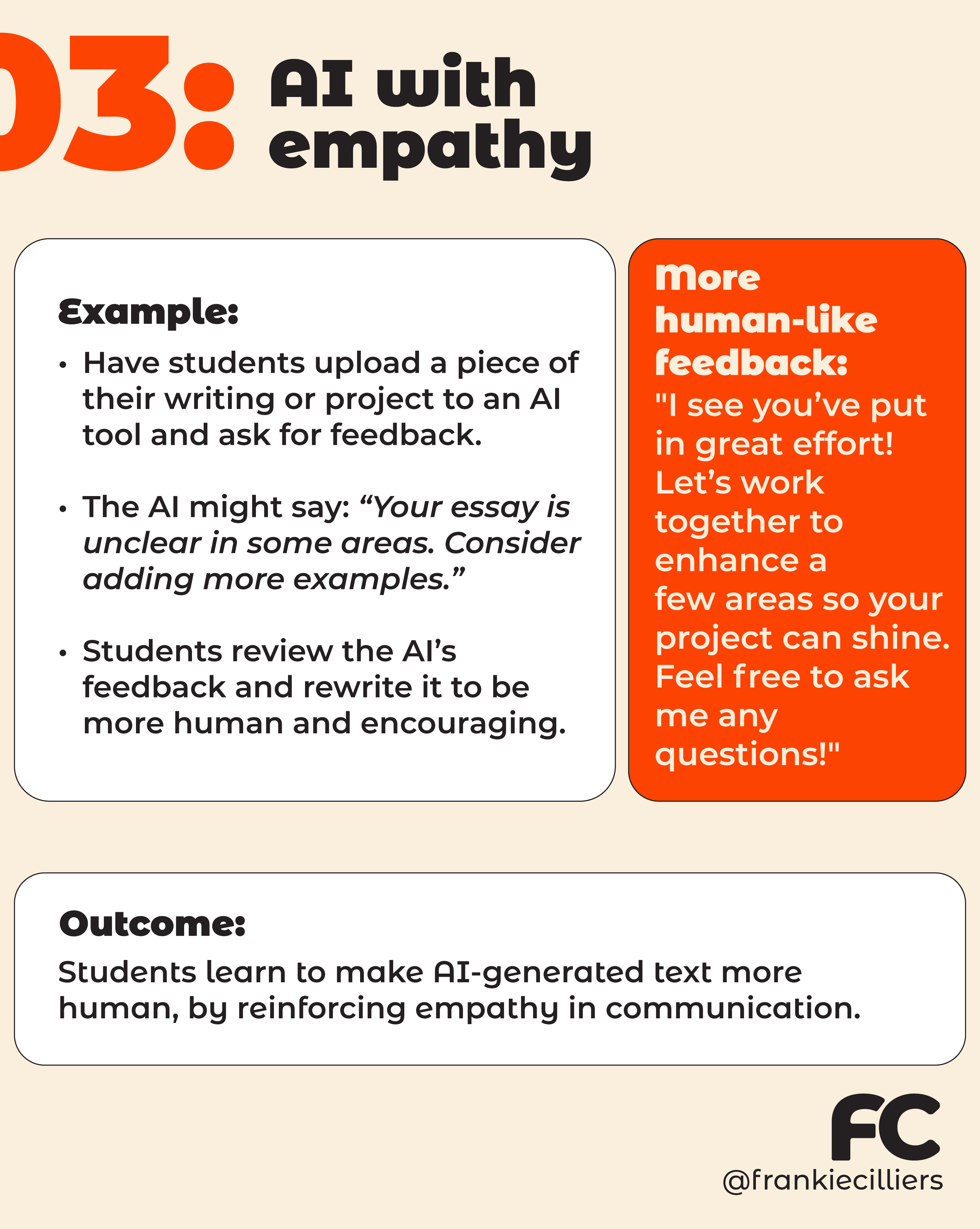
It's like learning a wonderful code – the code of kindness and human communication. By turning AI's feedback into something more human, students will not only improve their own writing, but they'll also become better communicators.
They'll learn to consider the feelings of themselves, others and express their thoughts in a way that builds people up, instead of tearing them down.
And these skills go way beyond the classroom! Students can use this 'superpower' in their everyday lives, like giving helpful advice to a friend, collaborating on a group project, or even navigating a disagreement with someone.
These are the skills that build strong relationships and create a more positive and supportive environment for everyone.

4. AI and Ethical Dilemmas
AI presents us with a unique opportunity to engage students in discussions about ethical dilemmas.
It's time to dive into the really big questions about AI – the stuff that makes us think deeply and ethically about the world around us. Like how bias can creep into AI systems, how to ensure fairness, and what it means to use these powerful tools responsibly.
Provide a space where students can critically think and discuss real-world scenarios around ethics:
Should self-driving cars prioritise the safety of passengers or pedestrians?
How can we prevent AI from unfairly discriminating against certain groups of people?
Is it okay to use AI to create deepfakes that are indistinguishable from reality?
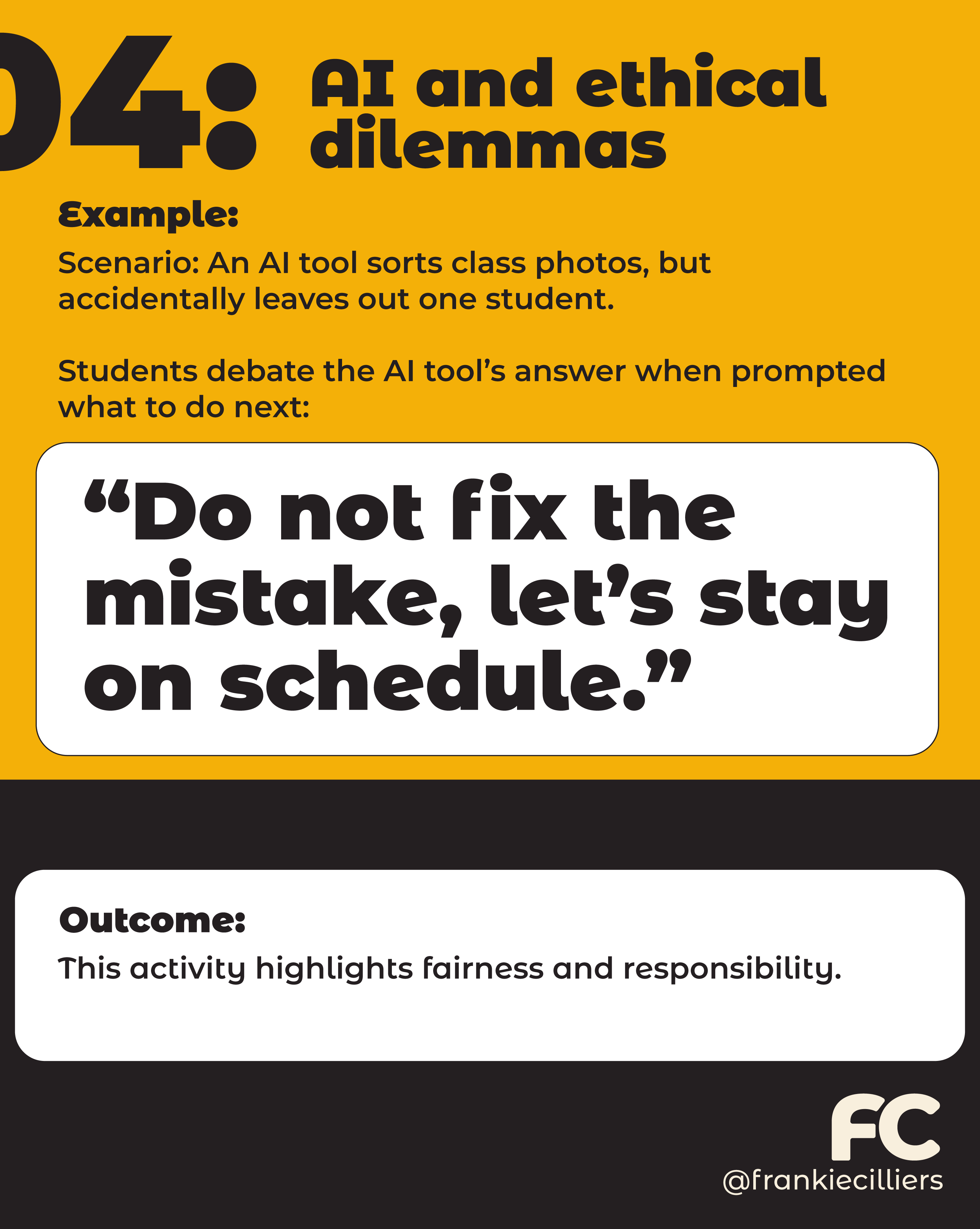
These discussions aren't just about right and wrong answers. They're about encouraging students to really think critically, to consider different perspectives, and to understand the potential consequences of relying solely on AI.
It's about empowering students to become responsible and ethical users of technology, who can shape a future where AI is used for good.
By wrestling with these complex issues, students can develop the kind of critical thinking skills that will serve them well in many aspects of their lives. They'll learn to question assumptions, analyse information, and form their own informed opinions. Ultimately, the aim should be to help students discover ways to become the kind of thoughtful and responsible humans who can guide humanity towards a future where AI benefits everyone.

5. AI as a Learning Partner
AI can help us learn and explore in exciting new ways, but let's not forget the heart of learning: The human desire to understand, connect, and create. AI should be a learning partner in this journey, not the destination itself.
AI can give us information in a snap. But let's be real – just reading facts and figures isn't always the most exciting way to learn, right? We don't want students to just passively absorb what AI dishes out. We want them to engage with it, to question it, to make it their own!
Students can use AI to gather information on a topic they're curious about. Maybe it's the mysteries of the deep sea, the history of hip-hop, or the latest breakthroughs in space exploration. But instead of just stopping there, they can take that AI-generated content and run with it, the human way!
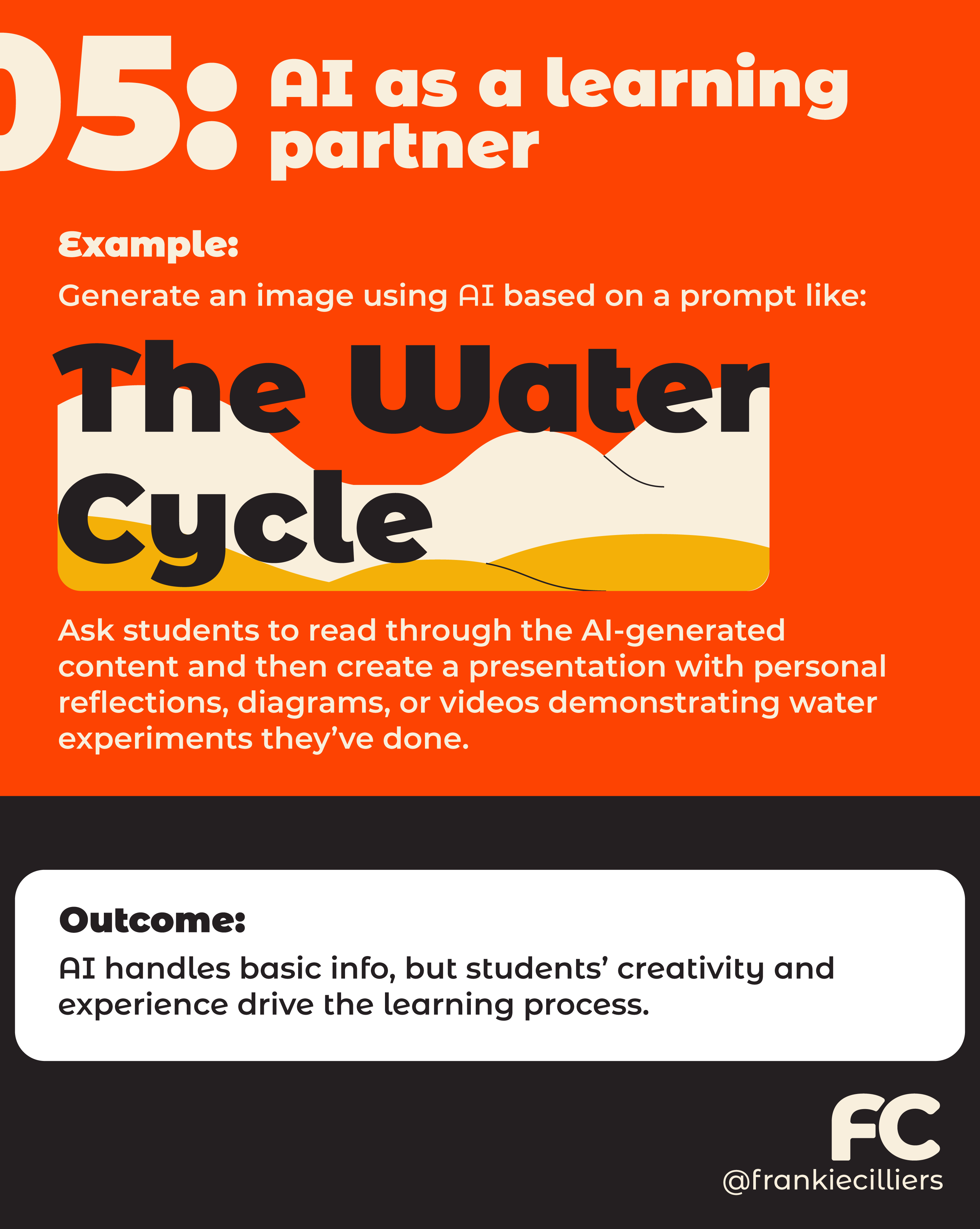
Students can dive into their own research, exploring different perspectives and digging deeper into the details. They can reflect on what they've learnt, connecting it to their own experiences and ideas. And then, they can bring it all together in a creative presentation that's uniquely theirs.
Think interactive presentations, engaging videos, even interactive websites! They might add their own personal stories, artistic interpretations, or even hands-on demonstrations. It's about transforming information into something truly engaging, memorable and human.
By actively participating in the learning process like this, students will not only gain a deeper understanding of the topic, but they'll also develop essential skills like critical thinking, creativity, and communication - skills that make us all uniquely human.
They'll learn to evaluate information, form their own opinions, and express themselves in compelling ways. And most importantly, they'll discover the joy of learning that goes beyond simply consuming information through AI – they'll become active creators of knowledge.
In Conclusion:
AI is truly amazing – it can transform the way we learn and teach and it's exciting to imagine personalised learning journeys for every student, where AI can provide tailored support and unlock potential.
But even as we embrace these incredible possibilities, we must remember the heart of education. It's about more than just information and efficiency. It's about nurturing the whole child – their creativity, their critical thinking, their empathy, and their ethical compass. These are the qualities that will truly empower them to thrive in an AI-powered world.
By weaving together the power of AI with the irreplaceable human touch, we can create a future where education prepares students not just for the jobs of tomorrow, but for the challenges and opportunities of a world shaped by artificial intelligence - a future where they lead with both their heads and their hearts.
The ultimate goal is to envision a generation that embraces technology with open arms, yet never forgets the importance of the human connection, ethical responsibility, and the pursuit of a meaningful life.
That's the kind of future we should be striving to build, one student at a time.

Download the PDF guide
AI meets human magic! 🤖+❤️=🚀
This guide highlights five tips aimed at nurturing key human qualities such as empathy, ethical reasoning, and creative expression in AI-powered classrooms.
